Author: admin

  • NYTimes : “Clean Energy Projects Are Booming Everywhere. Except in Poor Nations.”

    NYTimes : “Clean Energy Projects Are Booming Everywhere. Except in Poor Nations.”


    NYTimes : “Clean Energy Projects Are Booming Everywhere. Except in Poor Nations.”
    To read the full article on NYTimes website, please go 
    here

    A big obstacle is the lack of loans, a subject of intense disagreement between richer and poorer countries. But in Congo, a hard-fought solar investment shows a possible path forward.

    The future site of a solar plant in Goma, Democratic Republic of Congo.Credit…Moses Sawasawa for The New York Times

    The world is racing ahead with enormous investments in renewable energy, for the first time this year plowing more money into solar power than oil.

    But the world’s poorest countries, mostly in Africa, are effectively priced out of the action by a global lending system that considers them too risky for investment. Only 2 percent of global investment in renewable energy has been in Africa, where nearly a billion people have little or no access to electricity.

    It’s a paradox, Africa’s leaders argue. Clean energy projects would help stabilize their countries and economies, they say, reducing the very risk that investors say they fear. It’s an issue that looms large this week at a climate summit in Kenya, as it will at climate talks sponsored by the United Nations later this year in Dubai.

    It also preoccupies Archip Lobo, whose company, against the odds, raised $70 million in international funds this year — capping half a decade of effort — to build solar-powered microgrids in Congo.


    “A year ago, we were about halfway to losing hope,” Mr. Lobo said. “We were thinking, These lenders all want us to assure them there’s no political risk, no security risk. How can you do that in Congo?”

    He has lived that risk. At 8, Mr. Lobo was made a refugee. His brothers were forcibly recruited by the army, and other family members were raped.

    Yet he also embodies an entrepreneurial spirit that thrives in the Democratic Republic of Congo. Mr. Lobo, now 31, got a degree and co-founded a company that roasts some of the delectable coffee that grows in eastern Congo.

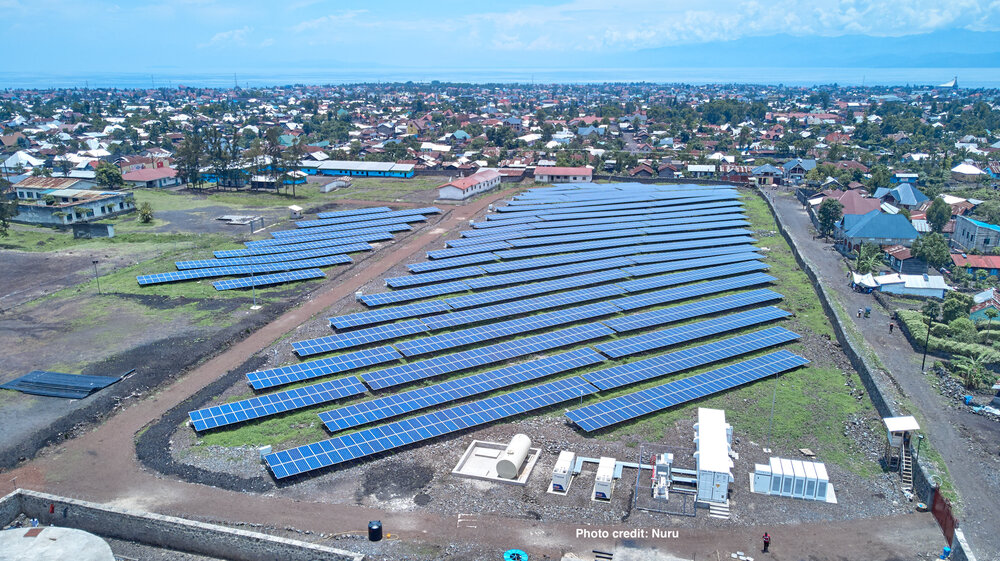
    Nuru, which builds solar-powered microgrids, can currently produce a little over a megawatt of electricity, which it distributes to 2,500 businesses and homes in Goma.Credit…Moses Sawasawa for The New York Times
    Archip Lobo, a founder of Nuru, at the site of the company’s first urban microgrid, in Goma.Credit…Moses Sawasawa for The New York Times

    While his second company, Nuru — the word means “light” in Swahili — is small by global standards, investments like these are important, experts say, because if the pattern of clean energy investment doesn’t change, by midcentury more than three-quarters of all carbon dioxide emissions could come from the least-developed countries, whose populations and economies are growing faster than anywhere else.


    Like many businessmen across Africa, Mr. Lobo found himself stymied by the price and paucity of electricity. His coffee company relied on just an hour or two of power from a generator fueled by diesel that had to be trucked thousands of miles from ports in Kenya and Tanzania.

    He co-founded Nuru to try to solve that problem. It negotiated a partnership with a consortium of philanthropic funds, anchored by the Bezos Earth Fund and the Rockefeller and Ikea foundations, that agreed to put in the majority of the recent funding, which is intended to give Nuru a chance to prove that, rather than being a risky investment, it is an enterprise that can make money and transform the local economy.

    “We’re trying to use philanthropic money to create proof points to get the market moving and show it’s less risky than international lending institutions and private banks think,” said Simon Harford, the chief executive of the consortium, known as the Global Energy Alliance for People and Planet.


    With the money, Nuru will increase its urban microgrids in Congo to four, from one, and be able to produce 13 times as much electricity. The company eventually hopes to provide millions of Congolese with cheaper and more reliable electricity than what is produced by the diesel generators that most now use.


    More than 70 million of Congo’s 100 million people cannot afford or access electricity. Its population is currently growing faster than new electricity customers are being brought online.

    Ezekia Rubona owns a small shop in Goma that previously relied on diesel generators for electricity.Credit…Moses Sawasawa for The New York Times
    A welding workshop in Goma, one of many small businesses that stand to benefit from greater availability of electricity.Credit…Moses Sawasawa for The New York Times

    “I pay three times less to Nuru than what I paid for diesel, so you can imagine what it means for my business,” said Ezekia Rubona, 27, who runs a shop where people can make photocopies, print banners, upload videos and surf the internet. “That generator, too, it always surged. We would lose machines that way.”


    While the financing is a major breakthrough for Nuru, the company is receiving it at an interest rate of more than 15 percent, five times as high as interest rates for many renewable energy projects in wealthier countries where companies have easier access to credit. Nuru also can’t afford to hire a seasoned chief financial officer. It could barely pay its small team over the years for trying to wrangle an investment that elsewhere in the renewable energy world might seem paltry.

    The clincher, said Mr. Lobo, was getting investors to actually come to Congo. That was only made harder by an Ebola epidemic in the region and then Covid-19, as well as unrest that is so persistent it rarely makes global headlines. On the day a New York Times reporter arrived in the city of Goma to visit Nuru’s existing microgrid, state security forces killed more than 40 people who were gathering for a protest against the presence of a longstanding U.N. peacekeeping force widely seen as ineffective and a source of corruption.

    A day later, Goma was back to its usual bustle.

    “Investors are human beings too,” Mr. Lobo said. “Once you come here and see the hunger for energy, the potential for growth, you can finally look past the risks and see what a transformative investment this will be, a real, genuine business opportunity.”

    What African leaders gathering in Nairobi, Kenya, this week for the first-ever Africa Climate Summit hope to do is persuade global investors and multinational development banks like the International Monetary Fund that African companies need not only more deals like Nuru’s but also better ones.

    A “cinema hall” in Goma that has operated longer hours since it began buying power from Nuru.Credit…Moses Sawasawa for The New York Times
    Streetlights powered by Nuru. Credit…Moses Sawasawa for The New York Times

    There’s a term, “concessional,” for certain kinds of international loans that are designed to help less wealthy international borrowers. The idea is that loans might have below-market interest rates or grace periods for repayment.

    Nuru’s loan is anything but concessional.

    But the idea is to prime the pump for bigger investments. “The multinational banks are the ones who need to be the mobilizers-in-chief,” said Chavi Meattle, an expert on climate finance in Africa at the Climate Policy Initiative, a nonprofit research group. “They’ve made promises to reform, but they are not following through fast enough.”

    Ms. Meattle co-wrote a paper last year outlining the flow of climate investments into Africa, which found that a vast majority of what was already a small pool of money went to just a few of Africa’s most advanced economies, like Egypt, Morocco and South Africa.

    In smaller countries like Sierra Leone, those seeking to develop renewable energy face an even steeper uphill battle than Nuru, which has Congo’s large population and famed natural resources as points of reference for potential investors.


    Kofie Macauley, a Sierra Leonean engineer, has been trying to raise money for a hydroelectric project in a rural area of the country for a decade. He has courted roughly 60 equity partners, big and small, from around the world, for a dam that costs $80 million, a humble sum as far as such projects go. All the groundwork is complete. The money is the only thing.

    “I just can’t provide the guarantees they insist on,” Mr. Macauley said. The dam project, while small, could “change the whole course of Sierra Leone’s history,” he said, providing power to as many as two million people who now lack it.

    “The big banks are too risk-averse to see that,” he said. “So the rest of the world will ride a Ferrari, and we stay on the bicycle.”

    Max Bearak

    By Max Bearak

    Reporting from the Democratic Republic of Congo, where a solar company recently raised more than $70 million.

    Sept. 4, 2023

  • Nuru Closes over $40m of Equity Funding to Drive Metrogrid Scaling in the Democratic Republic of the Congo

    Nuru Closes over $40m of Equity Funding to Drive Metrogrid Scaling in the Democratic Republic of the Congo

    Nuru, one of Africa’s pioneering renewable energy-powered metrogrid companies, has announced the successful close of over $40m in Series B equity funding and anticipates the close of an additional $28m in project finance by the end of the month. The funds will enable Nuru to commence construction on 13.7 MWp of projects, which will significantly expand its existing operating assets in eastern Democratic Republic of the Congo (DRC) and help bridge the enormous energy gap in the country.

    Less than 20% of the DRC’s population has access to energy, and with a rising energy demand projected for the future, Nuru’s innovative approach to renewable energy access unlocks the immense market potential across the country. The company’s utility-scale solar metrogrids, integrated with cutting-edge technology and services, are designed to provide 24/7 reliable and renewable energy to DRC’s urban communities, fostering climate resilience and sustainable development.

    The $40m in funds come from market-leading equity investors including the International Finance Corporation (IFC), the Global Energy Alliance for People and Planet (GEAPP), the Renewable Energy Performance Platform (REPP), Proparco, E3 Capital, Voltalia, the Schmidt Family Foundation, GAIA Impact Fund, and the Joseph Family Foundation. Additionally, IFC’s equity investment includes financing from the Finland-IFC Blended Finance for Climate Program.

    Jonathan Shaw, co-founder and CEO of Nuru, said: “We are thrilled to partner with such a dynamic group of investors who are keen to drive our vision of expanding energy access and transforming 5 million lives in the DRC. Closing the Series B is a significant milestone in Nuru’s journey, but also demonstrates the viability of the metrogrid model in the distributed energy sector in Africa. Nuru extends its heartfelt appreciation to the consortium of investors for their visionary support and unwavering commitment to Nuru’s vision. Together, we will continue to illuminate lives, drive economic growth, and empower communities across the DRC.”

    Following the Series B close, Nuru will begin work immediately on three transformational projects in Goma, Kindu, and Bunia, which will have a combined capacity of 13.7 MWp. The Bunia site will become the largest off-grid solar hybrid metrogrid in sub-Saharan Africa.

    Nuru’s Series A was led by E3 Capital (formerly Energy Access Ventures) in 2018 together with EDFI ElectriFI, the EU-funded Electrification Financing Initiative, managed by EDFI  Management Company. Their investment was catalytic in building Nuru’s current operating metrogrid portfolio in the cities of Goma, Beni, Tadu, and Faradje.

    Today’s announcement comes after initial investments in March from REPP, Proparco, and E3 Capital bridged a financing gap to bolster the Series B equity fundraise. REPP, which is funded by the UK’s Foreign, Commonwealth and Development Office (FCDO) and managed by Camco, Proparco, which is the private sector financing arm of Agence Française de Développement Group (AFD), and E3 Capital, which is a leading investor in low-carbon early-stage companies, each committed $500,000 in a convertible note round earlier in the year.

    AltRaise acted as exclusive financial advisor to Nuru on both the Series B transaction and accompanying project finance.

    Pull Quotes:

    IFC Country Manager for the DRC, Malick Fall, said: “Expanding access to electricity is instrumental to supporting economic growth and improving living standards for people and businesses in the DRC. IFC’s support for Nuru will play a pivotal role in helping to bridge the energy access gap by using an innovative business model, new technology and more climate friendly power sources.”

    GEAPP’s VP for Africa, Joseph Nganga, said: “The DRC suffers from one of the lowest electrification rates in the world with global supply issues hampering its immense renewable energy potential. GEAPP’s contribution to Nuru’s Series B fundraise, alongside an impressive slate of market-leading investors, will help communities connect and transition to reliable renewable energy. By working together at pace, we can lift millions of people out of poverty, transform livelihoods and drive economic growth in DRC, and across the region.”

    British Ambassador to the Democratic Republic of the Congo, Alyson King, said: “We welcome the commitment shown by this group of investors to expanding energy access in Eastern DRC. UK support to Nuru, in partnership with others, has demonstrated how innovative energy companies have the potential to improve the lives and livelihoods of the people of DRC.”

    REPP Lead at Camco, Benjamin Hugues, said: “REPP’s follow-on investment in Nuru’s Series B
    round is evidence of our continued belief in Nuru’s ability to address DRC’s material energy access deficit. The company’s Series B round comprises an impressive list of investors of all types, and is a great example of how catalytic funding from REPP and its public sector funding partners can help de-risk investments in the sector, ultimately leading to increased private sector participation in tackling some of these challenges.”

    PROPARCO’s Principal on the Venture Capital Team, Natascha Korvinus stated: “We are extremely pleased to further enhance our support to Nuru in this important scale up phase. The company improves access to renewable energies with an innovative and sustainable business model in a fragile context, meeting core objectives of both PROPARCO’s new impact strategy to reduce inequalities through joint action, as well as our Venture Capital ARE Scale-Up programme, supported by the European Union, which aims to enhance access to finance for off-grid projects like Nuru across Africa.”

    E3 Capital’s Deal Lead and Venture Partner, Elizabeth Biney-Amissah: “Having taken the earliest risk and led investment continually in Nuru over the past 5 years since 2018, it is an honor and with immense pride that we close this round with this esteemed group of co-investors to support Nuru’s ability to catalyse economic development through energy access and productive use in DRC. Each investor brings vital resources, know-how, and expertise that will be essential to Nuru’s capacity to continue to grow its portfolio to provide clean energy to millions in this key frontier market. With this close of the Series B round, the commercial viability of the metrogrid model in the distributed energy sector is further cemented as a key energy access asset that will transform how we will be able to electrify more of Africa
    and the emerging world to come. We congratulate Jon, Archip, Juliana, and the whole Nuru Team on this tremendous achievement and look forward to continued partnership into the next phase of growth and innovation.”

    Voltalia’s CEO Sébastien Clerc stated: “We are delighted to support Nuru’s projects with our investment and our partnership to codevelop photovoltaic sites. Nuru will play a key role developing the local economy with green power, and we are proud to contribute.”

    The Schmidt Family Foundation’s Portfolio Director of the Impact Investing Program, Aaron
    Mbati
    , said: “We are excited to support Nuru as they lead the way in expanding access to clean energy in such a critical region. The more companies like Nuru demonstrate the social and economic benefit of projects like these, the closer we move towards a more just and resilient world for people in Sub Saharan Africa.”

    Gaia Impact Fund’s Partner, Guilhem Dupuy, stated: “Having been involved with Nuru from the early stages, we have witnessed their remarkable and unwavering commitment to taking metrogrids from idea to full-scale implementation. This successful Series B is a testament to their resilience and dedication. We
    are honored to have played a part in their journey and are excited to continue our partnership as Nuru embarks on the next phase of growth, driving sustainable energy solutions and making a lasting impact in the region.”

    Joseph Family Foundation’s President Adrianne Ryder-Cook said: “Access to electricity, particularly from sustainable and climate-sensitive renewable energy, is fundamental for the future of the eastern DRC. The Congo River Basin holds the second largest rainforest in the world, and is one of the lungs of our planet. Led by the visionary team at Nuru, the metrogrid projects in Bunia, Kindu, and Goma will create positive, transformative change and advance Nuru in its goal to reach more than five million people.”

    European Union Ambassador to the DR Congo stated: “The European Union congratulates and encourages Nuru’s ongoing work in electrifying eastern Congo. From the dynamic city of Goma to the isolated towns of Faradje and Tadu, which were electrified for the first time, Nuru has created dozens of jobs, boosted the local economy, and improved the living conditions of hundreds of thousands of Congolese. Fortified by an initial investment from the European Union in 2018, through its ElectriFI financing tool, Nuru is expanding and looking forward to major achievements thanks to this new round of financing.”

    EDFI Management Company, ElectriFI Senior Investment Manager, Quentin Antoine said: “We are pleased to partner with such a group of investors allowing for an additional 13.7MW to be built. EDFI ElectriFI, the EU-funded Electrification Financing Initiative, has been invested since 2018. Through the years, we witnessed the company’s ability to develop and build metrogrids in challenging environments while servicing thousands and playing a pivotal role in reducing inequalities in East DRC. We would like to express our appreciation to the EU for the continued support, and the Ambassador of the European Union to the DRC and his team in particular. ”

    Notes to editors:

    For all media enquiries and interview requests, please contact
    Kyle Hamilton in the US atk.hamilton@nuru.cd, +1.255.456.6680 or
    Juliana Philippa Kerrest in Europe/Africa at j.kerrest@nuru.cd, +1.410.409.1683 or  +243.815.810.012.

    About Nuru

    Nuru (www.nuru.cd), meaning “light” in Swahili, seeks to provide energy that unlocks the incredible human potential in the Democratic Republic of the Congo. By delivering world-class renewable energy and connectivity services, Nuru aims to empower 5 million Congolese people, one connection at a time. Headquartered in Goma, Nuru has been at the forefront of transforming DRC’s energy landscape since it began in 2015.

    Investor and Partner Links

    International Finance Corporation (IFC)
    Global Energy Alliance for People and Planet (GEAPP)

    Renewable Energy Performance Platform (REPP)
    Proparco
    E3 Capital

    Voltalia

    The Schmidt Family Foundation

    GAIA Impact Fund
    Joseph Family Foundation

    EDFI ElectriFI

    AltRaise

  • DRC: Nuru connects 1.3 MW solar off-grid hybrid in Goma

    DRC: Nuru connects 1.3 MW solar off-grid hybrid in Goma

    The Nuru company put a mini hybrid solar power plant with a storage system into operation in Goma, the capital of the North Kivu province in the Democratic Republic of Congo (DRC). The installation has a capacity of 1.3 MW.

    The city of Goma has acquired a small hybrid power plant. The facility inaugurated on February 4, 2020 in the capital of the province of North Kivu in the Democratic Republic of Congo (DRC) is the work of Nuru. The Goma-based company has built a power plant in the Ndosho district. It consists of 4,000 panels, each capable of producing 335 W.

    The storage system of the Goma Hybrid Solar Power Plant©Nuru

    They are linked together by solar inverters that convert the energy transmitted by the sun’s rays into electricity. The entire solar system is thus capable of producing 1.3 MW. The installation is also equipped with batteries for storing the electricity, integrated in a container. Thus, after sunset, the power plant can continue to supply the population.

    Nuru’s projects in the DRC

    The solar power plant built by Nuru in Goma is also equipped with several back-up generators with a total capacity of nearly 364 kW. Electricity from the hybrid plant is distributed directly to the population via a mini-grid, also built by Nuru and equipped with transformers and a transmission line. “Nuru has (…) taken care to meticulously organise its electricity network, which includes 12 m high power poles for medium voltage and 8 to 10 m high poles for low voltage. These ecological poles, made of bamboo, are used to support the power cables that supply customers and for smart meters that measure customer consumption,” explains Nuru company.

    According to the company, launched in 2015, the commissioning of Goma’s hybrid off grid is the first step in a project that aims to provide electricity to 5 million people by 2024. Within 24 months, Nuru expects to generate an additional 23 MW by building solar hybrid plants in the provinces of North Kivu, Maniema, Ituri, Haute Uélé and Kasai.

    To implement its project, Nuru can count on the support of its partners, including off-grid providers Energy Peace Partners, Solarcentury, PowerGen Renewable Energy. The company is also supported by Energy Access Ventures (EAV), Electrification Financing Initiative (ElectriFI), an investment fund owned by the European Union, whose aim is to support the private sector in providing electricity in underserved

  • EPP authorized as I-REC country issuer in the DRC

    EPP authorized as I-REC country issuer in the DRC

    We recently reached a milestone on our path toward launching the Peace Renewable Energy Credit (P-REC). On October 3rd, the Democratic Republic of Congo (DRC) was added to the list of countries authorized to issue International Renewable Energy Certificates (I-RECs), and EPP was approved as the issuer of I-RECs in that country. This decision was taken by the Board of the I-REC Standard Foundation, which oversees I-REC markets. I-RECs are the dominant standard for energy attribute certificates (EACs) outside North American and Europe.

    The I-REC Standard Foundation Board decision is significant for four reasons:

    1)    It paves the way for EPP to issue P-RECs in the DRC. P-RECs issued from DRC will be I-RECs with an additional EPP label certifying the project’s peacebuilding co-benefits. P-RECs will be the first EACs ever to be issued from the DRC. The issuance of the first P-RECs will kickstart the Congolese EAC market and enable the monetization of new renewable energy generation. Renewable energy development will be supported by this new revenue stream. For example, P-REC revenue from the DRC pilot project – a 1.3MW solar battery mini-grid – will support our Congolese developer partner Nuru to install solar streetlights that enhance safety and security in the Ndosho neighborhood of Goma, in conflict-affected eastern DRC. P-REC revenue for Nuru’s subsequent projects will contribute to funding a pipeline of expansion projects throughout DRC.

    2)    It provides a new renewable energy purchase option for market actors in a region where EAC supply has historically been limited. Although the first P-RECs from DRC are slated to be issued in Q1 2020, a number of companies with a footprint in the region have already expressed interest in purchasing these P-RECs in order to meet their voluntary sustainability and/or corporate social responsibility goals.

    3)    It represents a vote of confidence by a dominant player in international renewable energy markets. We see the decision as an endorsement of our efforts to link international renewable energy markets with fragile states. These countries lack the traditional incentives and conditions for renewable energy investment. We have therefore designed P-RECs to support transformative renewable energy development in these conflict-affected, energy poor communities, with the ultimate aim of expanding the renewable energy revolution to fragile states. 

    4)    It expands the short list of I-REC issuing countries in Africa. DRC has one of the lowest rates of electrification and energy consumption and, at the same time, presents one of the most complex peacebuilding, humanitarian, and development challenges in the world today.  As a result of our efforts, DRC now joins South Africa, Uganda, and Morocco as I-REC issuing countries on the African continent. We have also prepared two P-REC pilot projects in South Sudan, and we are scoping additional P-REC projects in DRC, as well as new projects in Somalia, Uganda, and Mali. We hope to expand the list of P-REC-issuing countries further to include other fragile states in Africa and beyond.

    We’ve spent the past three years working to develop the P-REC: from publishing our ideas to evaluating peacebuilding impacts, from identifying pilot projects to establishing the transactional architecture, and from navigating carbon accounting rules to marketing and promoting PRECs. We are particularly grateful to the I-REC Standard Foundation Board and our Congolese developer partner Nuru, who have been instrumental partners in this journey. The issuance of the first P-RECs from the DRC is on the horizon, and we are eager to see the impact of P-REC-supported new renewable energy development on Congolese communities.

  • Gaia Impact Fund announces a milestone equity investment in Nuru, a minigrid developer and operator in the Democratic Republic of Congo (DRC)

    Gaia Impact Fund announces a milestone equity investment in Nuru, a minigrid developer and operator in the Democratic Republic of Congo (DRC)

    “Nuru is thrilled to be partnering with Gaia Impact Fund to bring millions of people renewable energy in the Democratic Republic of Congo”, says Jonathan Shaw, CEO of Nuru.

    Nuru, which recently commissioned a 1.3MW minigrid in Goma, DRC, aims to provide electricity to 5 million people by 2024 through solar hybrid minigrids. DRC represents more than half of the population of Central Africa and has also one of the lowest electrification rates, at just 15%. While minigrids have an increasing role to play as the least-cost solution in the future electricity mix in countries such as DRC, they have been a largely underfunded segment of energy access markets. Against this backdrop, Gaia Impact Fund is happy to announce its first investment in the minigrid sector.

    Hélène Demaegdt, President of Gaia Impact Fund, comments: “We are very proud to commit alongside Nuru, which has a first-to-market position in DRC and is in the process of deploying one the largest offgrid solar-based minigrid pipelines in Africa. All the connections created by Nuru’s projects are essential to address the needs of under-served urban areas and to displace diesel generation.”

    By offering a stable and reliable electricity supply, at a cheaper price than existing (and non-renewable) sources of energy, Nuru aims to directly serve commercial and industrial off-takers as well as to sell power to households, SMEs and institutions.

    “We are impressed by Nuru’s capable local team, successfully commissioning one of Africa’s largest minigrids in DRC’s complex and unstable environment”, says Guilhem Dupuy, Investment Director at Gaia Impact Fund. “We look forward to supporting Nuru to realize its scale up ambitions and to deliver on its mission in the country, alongside the impressive pool of investors and partners already committed around Nuru.”

    Gaia’s investment comes along with Energy Access Ventures (EAV), a leading investor in smart infrastructure in Africa and an active shareholder in the company. Nuru is also supported by ElectriFI, a flexible financial facility funded by the European Union.

    Jonathan Shaw adds: “Throughout the investment process, the team at Gaia Impact Fund demonstrated the agility, creativity, and commitment Nuru needs from its shareholders to navigate the unique challenges and opportunities that the DRC offers. We are excited to begin this journey with Gaia Impact Fund.”

    About Nuru

    Nuru (Swahili for “light”) is a mini-grid developer providing energy access through solar-hybrid systems in Democratic Republic of Congo (DRC). With the national electrification rate at just 15%, Nuru provides more affordable and reliable power for longer in the absence of the grid to Commercial & Industrial clients, Households, SMEs and Institutions that rely heavily on expensive diesel gensets for their power needs. The company was founded by Jonathan Shaw (CEO) who is backed by a local team with a deep understanding of the DRC business context, political landscape and regulatory environment.

    For more information check: https://nuru.cd/

    About Gaia Impact Fund

    Gaia Impact Fund is a French impact fund dedicated to energy access entrepreneurs. Gaia invests in startups and SMEs operating in Sub-Saharan Africa and South-East Asia, and active on various segments: solar kits, productive uses of electricity, minigrids, commercial & industrial solar installations, cleantech. Gaia Impact Fund was created by a team of entrepreneurs specialized in renewable energy and social impact investing. Since 2017, Gaia has supported 8 innovative companies in emerging countries and is actively pursuing its investment strategy with strong social and environmental impact.

    For more information check: www.gaia-impactfund.com

  • Nuru (former Kivu Green Energy) has just commissioned a 1.2MW site in Goma!

    Nuru (former Kivu Green Energy) has just commissioned a 1.2MW site in Goma!

    The Democratic Republic of Congo now has the largest off-grid solar hybrid production facility in sub-Saharan Africa. This installation is the work of Nuru SARL, a Congolese company working to improve connectivity to electricity for the people of DRC. 

    Jonathan E. Shaw, Chairman and CEO of Nuru SARL, had the honour of inaugurating the plant on the 4th of February 2020, in the presence of national and provincial authorities. “The system put into service today,” he explained, “is an uncompromising energy solution. We used the best technology in the world to produce this system. The quality of this production unit is comparable to any system of this scale anywhere on earth,” he said. 

    Nuru decided to focus its resources on the Ndosha district, considered neglected and plagued by insecurity due to, among other things, obscurity, according to the company’s press release.  The installation has nearly 4,000 solar panels, each with a generation capacity of 335Watts, giving a total output of 1.3MW. 

    Nuru has used ecologically friendly electricity poles, made from bamboo, to carry the electric cables that power its customers; smart meters measure and monitor customer consumption. 

    Nuru is determined to achieve its ambition of “providing 5 million satisfied customers with world-class connectivity by 2024” according to CEO Jonathan Shaw. The company is preparing to deploy an additional 23MW of hybrid solar capacity in the next 24 months, in Goma in North Kivu, Maniema, Ituri, Haut-Uélé and Kasaï . By the end of 2021, it aims to commission 7 sites across the DRC. 

    Nuru has entered into a partnership with SNEL, which will allow the company to “provide up to 150MW of extended power to the grid in the Northeast.” By realizing all this work, Nuru’s end goal is to “establish a corporate culture in the Congo which embodies our values of relentless growth, the highest levels of quality, integrity and commitment.” 

    Nuru is a Congolese company founded in August 2015 in Beni by Jonathan Shaw and Archip Lobo under the name “Kivu Green Energy”. In September 2019, the company changed its name to “Nuru”, a Swahili word meaning Light. This change of name “reflects its expansion beyond the regions of Kivu”. 

    Élan works with existing Renewable Energy actors to support specific products but to look for new entrants building on the success of previous work in the consumer sector. An area of interest for Élan is the possibility to use commercial and industrial off takers as ‘anchor’ loads which then allow the surrounding community or households to benefit from the resulting mini-grid. This has already been done successfully by Kivu Green energy in Beni by providing competitively priced electricity to surrounding businesses and households.